Back to all articles

Building Early Products: 10 FAQs with Matt Fitzgerald
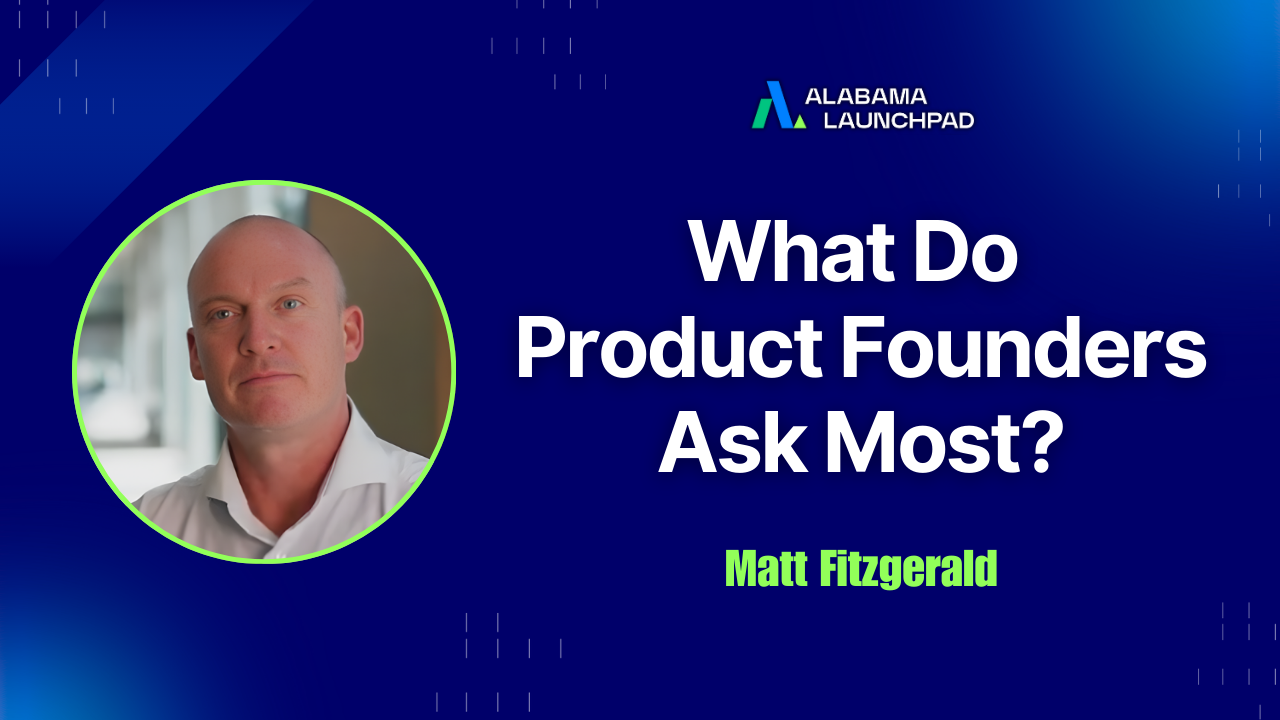
Early hardware teams don’t usually fail for lack of ideas; they stall because the next unit of proof costs money machining one part, outsourcing a quick fabrication, or paying for a small validation test. Advisor Matt Fitzgerald explains how Alabama Launchpad’s stipend solves that first-mile gap and why verticalized advisor matching gets founders relevant, actionable guidance. Cycle two also brings more applicants and greater diversity across industries, increasing energy and momentum. The throughline: prepared, engaged founders move faster when they have a little capital and a mentor who understands their exact product path. These FAQs distill Fitzgerald’s front-line lessons so teams can translate advice into immediate execution.

FAQs

What makes early product development challenging?

Short answer: Physical products demand paid technical work machining, fabrication, lab tests that founders often can’t afford at the start. Long answer: In the earliest stage, progress hinges on tasks with price tags: a one-off machined bracket, a custom cut, or brief outsourced testing. Fitzgerald notes teams frequently needed a modest purchase sometimes as little as $700 to move forward, yet didn’t have it. Without these small spends, learning slows and milestones slip. That’s a different constraint from software, where iteration is mostly time. Hardware requires cash to convert ideas into verified parts and data.

How do stipends help founders?

Short answer: Stipends fund the next experiment now buying parts, outsourcing work, or booking tests that turn advice into progress. Long answer: Launchpad’s updated format gives finalists real dollars they can immediately deploy toward building product or software and outsourcing services when needed. Previously, advisors might recommend a step only to hear, “we don’t have the money.” Stipends remove that bottleneck so teams can legitimately “go do things,” especially in product categories where each iteration demands materials or vendor time. The result is faster cycles, concrete evidence, and momentum between advisor sessions.

Why is advisor matching important?

Short answer: Verticalized matching pairs founders with experts who’ve solved the same category’s problems, making guidance specific and usable. Long answer: Launchpad’s verticalized format connects applicants with advisors “that are experts in their field,” aligning mentorship to real-world constraints by industry. For hardware and other product teams, that means help from someone who knows supplier realities, tolerances, test plans, and cost/quality tradeoffs. Relevance compresses the distance from advice to action: you get targeted introductions, practical checklists, and “good-enough-for-now” standards rooted in your exact path not generic startup tips.

What’s different in cycle two?

Short answer: More applicants, a broader mix of company types, and greater energy around taking action with real dollars. Long answer: Fitzgerald describes cycle two as “really exciting” with the most applicants in a long time and increased diversity from life sciences to consumer products and beyond. That variety enriches peer learning and expands the advisor bench, while stipends and vertical matching ensure momentum. Collectively, the program keeps iterating, improving conditions for founders to progress from concept to execution with pace and confidence.

Why do founders stall before Launchpad?

Short answer: Small but essential, money-gated steps pile up, causing delays and lost momentum. Long answer: Many teams arrive with a smart plan but no funds for the next concrete action, like machining a piece or paying a fabricator. Advisors often tried to help gratis or find favors, but that’s not a process. Launchpad’s stipend transforms “we’ll do it if we win” into “we’ll do it this week,” restoring cadence. That shift helps founders collect the evidence needed for investor conversations and sharper decision-making.

What does Matt look for in early founders?

Short answer: Commitment, readiness to build, and the willingness to act on feedback quickly. Long answer: Fitzgerald responds to energy and engagement teams that show up prepared, ask concrete questions, and immediately translate advice into tasks. He values founders who are past vague ideation and ready to “do the work,” whether that’s ordering parts, scheduling tests, or refining specs. That posture makes advising effective and turns small amounts of capital into measurable product movement.

Why does energy matter in advising?

Short answer: Engaged teams create momentum, making advisor time more rewarding and impactful. Long answer: Fitzgerald became an advisor partly because it’s fun the teams’ enthusiasm “gets me fired up.” That energy isn’t cosmetic; it signals bias to action. When founders bring urgency and curiosity, conversations quickly turn into intros, quotes, or test plans. The positive loop energy → execution → results keeps everyone invested and accelerates learning across the cohort.

What types of companies apply to Launchpad?

Short answer: A wide range life sciences, consumer products/CPG, tech hardware, and more. Long answer: Cycle two highlights diversity across categories. Fitzgerald is especially excited by tech and life sciences, where teams solve tangible problems and convert ideas into businesses. While some consumer products may feel less aligned to his interests, he notes the program’s structure and matching let each company find the advisors and resources most relevant to their market and model.

How is product advising different from software advising?

Short answer: Hardware requires physical iteration, materials, vendors, and paid technical support; software iteration is mostly time. Long answer: With products, the “next build” involves POs, machining, cutting, or assembly and that costs cash. Advisors can’t just propose a change; someone must fabricate or test it. In contrast, early software iterations can be pushed overnight. This is why stipends matter more for product teams and why domain-aligned advisors are so valuable they understand the costed path to validation and how to prioritize tests that unlock the next decision.

What should founders focus on after Launchpad?

Short answer: Execute the next product milestones with clarity, using new resources and connections effectively. Long answer: Leave with a ranked backlog of money-gated tasks, pre-quoted where possible, and a test plan tied to your riskiest assumptions. Use advisor introductions for suppliers, labs, or short-run fabricators. Track methods, results, and decisions so learning compounds. The goal: convert stipend-scale dollars and network access into verified parts, cleaner specs, and evidence that propels the next round of funding or first customers.

Conclusion

Building physical products is a cash-and-execution game. Launchpad’s stipends fund the next proof, and vertical advisor matching delivers category-specific guidance. With more applicants and broader diversity in cycle two, founders who show up prepared and energetic can translate small dollars into real momentum moving from concept toward reliable, testable hardware.

Contact Us

Don’t do it alone. Pair your team with advisors who’ve walked your exact path, and use early capital to generate reproducible validation data. Call us today at (205)943-4700 and get started.

More About Alabama Launchpad

Established in 2006, Alabama Launchpad is Alabama’s most active early-stage seed fund investor, driving innovation and job growth through startup competitions and ongoing mentoring for Alabama entrepreneurs. . It is the state’s longest-running business plan and pitch competition. Over the past 19 years, Alabama Launchpad has invested more than $6.6 million in 124 Alabama startups. The winning startup companies have generated more than 1,600 jobs for the state and have a combined post-money valuation of more than $1 billion.

More About Our Partner, Innovate Alabama

Innovate Alabama is Alabama’s first statewide public-private partnership focused on entrepreneurship, technology and innovation with a mission to help innovators grow roots here in Alabama. Innovate Alabama was established to implement the initiatives and recommendations set forth in the Alabama Innovation Commission’s report, including smart policy solutions that will create a more resilient, inclusive and robust economy to remain competitive in a 21st-century world. With founding CEO Cynthia Crutchfield leading the charge, Innovate Alabama is also made up of a board of 11 innovation leaders appointed by Gov. Ivey, collaborating across sectors to advance industries, drive technology and facilitate an environment where innovation and entrepreneurship thrive. Learn more about Innovate Alabama at www.innovatealabama.org.