Back to all articles

The Real Challenges of Building Early Products
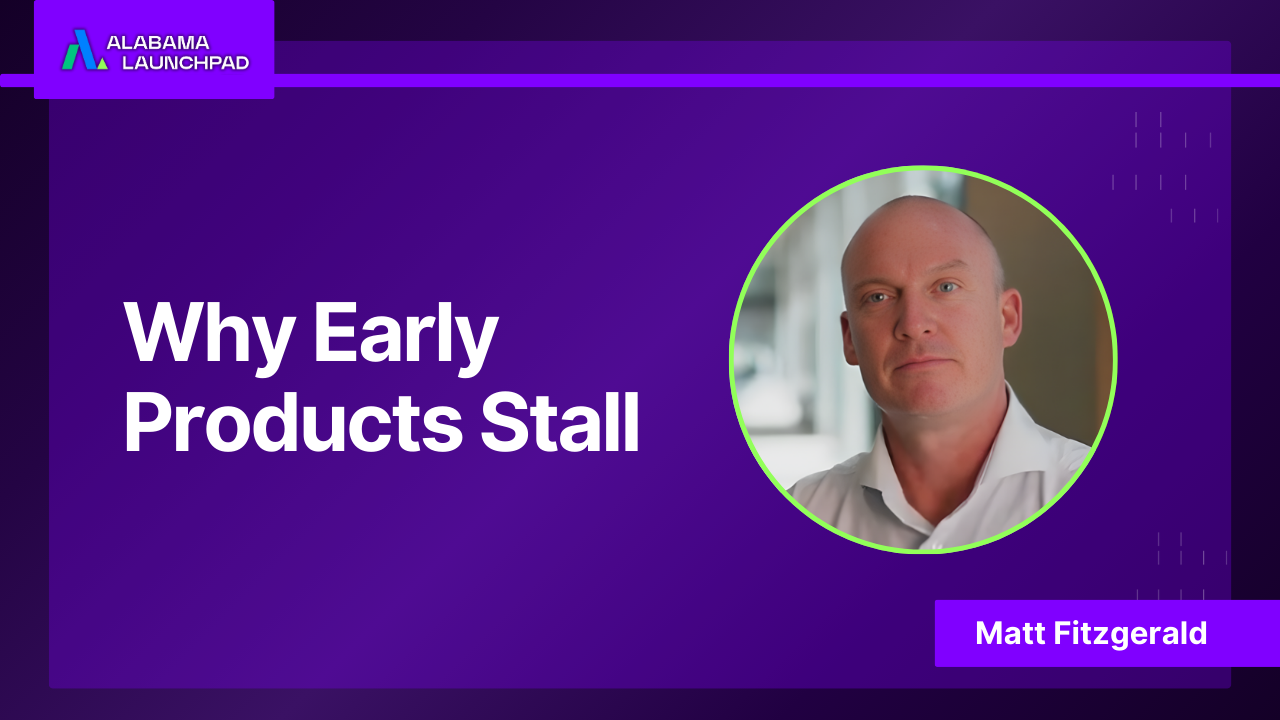
Early product companies don’t stall for lack of vision they stall for lack of cash to do the next essential step. In his conversation with Alabama Launchpad, advisor Matt Fitzgerald explains that physical-product teams routinely need “just one part machined,” a prototype fabricated, or a quick outsourced test and can’t afford it yet. Launchpad’s new stipend structure addresses that gap so teams can act on advisor guidance immediately. The program is also verticalizing mentor matching to ensure founders get industry-relevant help, not generic tips. And with more applicants and more diversity in cycle two, the ecosystem is iterating toward what builders truly need: actionable capital, expert pairing, and a repeatable process to move from concept to execution.

Key Takeaways

Product companies face higher early technical costs than software teams.

Machining, fabrication, and bench testing cost real dollars often before revenue.

Stipends allow founders to execute meaningful early steps.

Small, immediate capital lets teams “legitimately go do things” right now.

Verticalized matching pairs teams with industry-aligned advisors.

Founders work with experts who’ve solved the same category problems.

Cycle two has more applicants and more diversity.

Momentum is rising across life sciences, tech, and consumer products.

Prepared founders move faster and gain confidence.

Structure plus small amounts of capital convert advice into progress.

“So many times the teams we were working with just needed like a part machined… ‘yeah, but I don’t have $700.’ It’s nice for them to have some money to legitimately go do things, especially on the product side where they are really moving something forward.”


Hardware Isn’t Broke, It’s Broke

Great hardware founders don’t lack bold ideas; they lack cash for the next unit of proof. As advisor Matt Fitzgerald puts it, teams get stuck when the to-do list requires dollars: machine a bracket, pay a fabricator, buy test time. In the earliest innings, even a few hundred dollars can be the difference between “we think” and “we know.” That’s a fundamentally different constraint than early software, where iteration often costs time more than money. When the next experiment has a vendor invoice attached, progress pauses.

Why Stipends Change the First Mile

Launchpad’s updated format gives finalists stipends small, immediate, earmarked capital to move. In the past, advisors could outline the right next step, but founders would say, “we don’t have the budget.” That forced mentors to either do favors, hunt discounts, or hope for a later prize. Stipends solve the bottleneck: founders can outsource a quick cut, pay for prototype assembly, or run a verification test this week, not “after we win.” Crucially, stipends turn advice into action and momentum into data.

Verticalized Matching Beats Generic Advice

Another shift: verticalized pairing. Instead of rolling the dice on a generalist, teams are matched with advisors who’ve built in similar categories life sciences, tech hardware, or complex consumer products. Relevance matters. A category-savvy mentor knows where tolerance stacks will bite you, which vendors to call, and what constitutes a “good enough” test for this stage. That calibration shortens the distance between guidance and go.

Cycle Two: More Applicants, More Diversity, More Momentum

Fitzgerald notes that cycle two brings the most applicants in a long time and greater diversity across verticals. That mix is healthy: it raises the bar, expands the playbook, and deepens the bench of examples founders can learn from. It also compounds advisor energy builders feed off other builders, and a bigger, broader cohort increases the chance that someone nearby has solved the thing you’re stuck on today.

How Prepared Founders Move Faster

Prepared founders aren’t luckier; they’re pre-decided. They show up with a prioritized list of experiments, pre-qualified vendors, and if-this-then-that branches. Give them a stipend and a relevant advisor, and they convert capital into evidence quickly. Fitzgerald’s engineering lens favors structure and iteration: pick the riskiest assumption, design the cheapest test that kills it or clears it, and reinvest the lesson. With a few targeted purchases and a couple of vendor POs, a “concept” becomes a tested mechanism, a “sketch” becomes a prototype under load, and a “maybe” becomes a measured delta.

A Practical First-90-Days Playbook

  • List the money-gated steps. Identify which tasks require a vendor invoice versus time only.
  • Pre-quote the top three. Get ballpark costs and lead times so stipend dollars land fast.
  • Run a single-variable test. Prove or disprove the riskiest assumption with the smallest spend.
  • Document like a grown-up. Capture methods, results, and next decisions future you (and investors) will thank you.
  • Leverage vertical advisors. Ask for intros to specific shops, labs, or testers; don’t reinvent the vendor map.


FAQs

Why do early hardware teams stall?

Short answer: Because essential steps machining, fabrication, and testing cost money they don’t yet have. Long answer: In hardware, the “next iteration” isn’t just a keystroke. It’s a vendor PO, a minimum order, or paid lab time. Without immediate funds, founders delay experiments that convert ideas into evidence. Stipends bridge that gap so teams can pay for a cut part, a quick jig, or a verification run now turning guidance into results and unlocking the next decision with confidence.

How do stipends improve outcomes?

Short answer: They turn coaching into action by funding the very next experiment. Long answer: Advisors can pinpoint the right next move, but execution often requires cash. A stipend lets founders act on advice the same week ordering components, booking tests, or outsourcing a tricky operation. That immediacy accelerates learning cycles, reduces thrash, and keeps momentum high between sessions. The compounding effect is more tested assumptions, cleaner narratives, and faster progress toward customers and capital.

What does “verticalized matching” actually change?

Short answer: You get advisors who’ve solved problems in your exact category. Long answer: Category context shortens learning. A life-sciences device mentor, a robotics engineer, or a complex-CPG builder brings pattern recognition about tolerances, suppliers, regulatory waypoints, and “good enough” proof. Their guidance is more specific, their intros more on-target, and their bar for evidence better attuned to your path saving you time and avoidable spend.

What’s different about cycle two?

Short answer: More applicants, broader company mix, and stronger energy across the cohort. Long answer: Cycle two features the most applicants in a long time and a wider spread life sciences, consumer products, and more. That diversity increases peer learning and expands the pool of vendor and advisor connections. Combined with stipends and expert matching, the program is iterating toward a builder-first model that converts ambition into measurable progress.

How should founders prepare to use small dollars well?

Short answer: Pre-quote tasks, prioritize the riskiest assumption, and spend to get decisive data. Long answer: Before funds arrive, line up vendors, rough prices, and lead times. Choose one assumption that most threatens your plan and design the cheapest test to kill or clear it. Spend on parts or services that produce yes/no answers, not vanity artifacts. Document results and immediately plan the next iteration keeping the loop tight and evidence-driven.

Contact Us

Don’t do it alone. Pair your team with advisors who’ve walked your exact path, and use early capital to generate reproducible validation data. Call us today at (205)943-4700 and get started.

More About Alabama Launchpad

Established in 2006, Alabama Launchpad is Alabama’s most active early-stage seed fund investor, driving innovation and job growth through startup competitions and ongoing mentoring for Alabama entrepreneurs. . It is the state’s longest-running business plan and pitch competition. Over the past 19 years, Alabama Launchpad has invested more than $6.6 million in 124 Alabama startups. The winning startup companies have generated more than 1,600 jobs for the state and have a combined post-money valuation of more than $1 billion.

More About Our Partner, Innovate Alabama

Innovate Alabama is Alabama’s first statewide public-private partnership focused on entrepreneurship, technology and innovation with a mission to help innovators grow roots here in Alabama. Innovate Alabama was established to implement the initiatives and recommendations set forth in the Alabama Innovation Commission’s report, including smart policy solutions that will create a more resilient, inclusive and robust economy to remain competitive in a 21st-century world. With founding CEO Cynthia Crutchfield leading the charge, Innovate Alabama is also made up of a board of 11 innovation leaders appointed by Gov. Ivey, collaborating across sectors to advance industries, drive technology and facilitate an environment where innovation and entrepreneurship thrive. Learn more about Innovate Alabama at www.innovatealabama.org.